Should You Become a Full-Time Writer? The Pros and Cons

Image courtesy of Feelart/ FreeDigitalPhotos.ne
Should you become a full-time writer? That depends.
What are Some of the Pros?
No doubt, there are plenty of highs when you become a published, full-time writer. Such as:
- Seeing your name in print — There’s something incredibly satisfying about holding a book with your name on the cover and thinking, I actually wrote this.
- Doing what you love every day — You get to spend your working hours doing something creative and meaningful.
- Having complete control of your time — No boss, no commute, and no asking permission to take the afternoon off.
- More time to write — Instead of squeezing writing into evenings and weekends, you can actually devote substantial time to your craft.
- Building a body of work — Over time, you can look back and see a collection of books, articles, essays, or stories you’ve created.
- The satisfaction of being called a writer — Especially for someone who has always dreamed of writing, making it your profession can feel like finally claiming that identity.
- Connecting with readers — Getting an email, review, or message from someone who connected with your words can be incredibly rewarding.
- Learning something new every day — Writing often means researching, interviewing, learning publishing, marketing, technology, and subjects you never expected to know about.
The Other Side of Writing Life
Now let’s talk a little about the downside.
Don’t get me wrong. As a professional writer, I am eternally grateful to be able to make a living doing what I love best.
However, following your passion certainly has its ups and downs.
A full-time writer must deal with the financial challenge of earning a living, the constant deadlines, the inevitable rejections, and the isolation.
Famous writers have explained the torture well:
“Writing a book is a horrible, exhausting struggle, like a long bout of some painful illness. One would never undertake such a thing if one were not driven on by some demon whom one can neither resist nor understand.” —George Orwell
“The freelance writer is a man who is paid per piece or per word or perhaps.” —Robert Benchley
“I would advise anyone who aspires to a writing career that before developing his talent he would be wise to develop a thick hide.” —Harper Lee
All true. Writing is one heck of a rollercoaster ride!
Would I change anything? Heck no! But I did learn some hard lessons along the way.
My Writer’s Journey
I was beyond excited when my first short story was published. My first check was only for $20, but I was still thrilled.
Afterward, several articles were published in magazines. Feeling confident, I decided to jump into becoming a full-time writer. Let’s just say, it didn’t go so well.
Writing as a hobby was different; it was a thrill just to see my byline. But as a business, writing was super frustrating. Editors didn’t answer my queries. Smaller magazines paid on publication, not acceptance, which often meant waiting months or even a year for payment. A few editors held articles for possible publication for months, then sent a standard rejection letter.
By jumping the gun too soon, I was forced to temp as a receptionist at a hotel chain to make ends meet – a job I absolutely detested. Some days were spent crying in frustration, and I swore off writing – not for the first or last time.
Many years later, I was finally able to become a full-time writer, but the highs and lows continued.
For instance, when an agent agreed to represent my first YA novel – oh, what a high that was! I was dancing on tables. But when the book didn’t sell and my agent dumped me, my self confidence and emotions took a dive.
Later, I received three journalism awards and had a book I co-wrote published by McGraw Hill. I was on top of the world!
Then my second novel was rejected by agents and publishers sending me crashing to the ground.
You get the picture.
So how do you stay happy through the crazy ups and downs if you want to be a full-time writer?
Advice for Aspiring Full-Time Writers
- As I learned the hard way, don’t quit your daytime job before you have a steady income. By the way, most writers have a source of back-up income or a part- or full-time job so they can live out their dream.
- If you want to write full-time, come up with a plan of action. List your monthly and yearly goals. It’s great to have a passion and a dream, but if you don’t have a plan in place, it won’t become a reality. Be prepared. Becoming a professional writer takes time, effort, patience, perseverance, and sheer determination.
- Talk to your partner. You are going to need his or her support. Be honest and realistic. Have a time-frame for meeting your goals. If it takes longer than anticipated, and there’s an excellent chance it will, have a good backup plan.
- Don’t put all your eggs in one basket. In other words, don’t make your whole world about writing and publishing or you will go completely bonkers. Have a well-balanced life that includes time for your spirituality, your loved ones, and other interests.
If you are truly meant to be a writer, you won’t give up or allow all the many setbacks to discourage you to the point of quitting.
Ray Bradbury, who I was privileged to hear speak at a writer’s conference years ago, always had the best advice. Here’s one of his great quotes:
“Just write every day of your life. Read intensely. Then see what happens. Most of my friends who are put on that diet have very pleasant careers.”
What if that doesn’t happen? You have other options.
Supporting Your Writing Habit
Before you decide that becoming a full-time writer is the only way to take your writing seriously, consider another option: keep your source of income and let it support your writing habit.
The truth is, most writers don’t make enough from their books to pay all the bills. Many have full-time or part-time jobs, freelance work, a business, or other sources of income that allow them to write without the pressure of having to make money from every word they put on the page.
And there’s something freeing about that.
When your mortgage, groceries, and electric bill don’t depend on your latest book, you can write what you want to write. You can experiment, take your time, or even write something that might never make a dime.
For some writers, this may actually be the better choice. Instead of turning something you love into a job – with deadlines, sales goals, marketing demands, and the constant pressure to produce – you can keep writing as something that brings purpose and enjoyment to your life.
A paycheck can do more than pay the bills. It can buy you the freedom to write without worrying about whether your writing is paying the bills, too.
Write for the Joy of It
One more piece of advice: Writing should be a satisfying experience on its own. Getting into print is just a bonus.
Don’t live and die by whether you get published or not.
Financial success is not the measure of your success as a writer.
As Allen Ginsberg said, “To gain your own voice, you have to forget about having it heard.”
Simply writing in a journal can be rewarding as I wrote in my blog. Or expressing yourself through poetry is a wonderful creative outlet.
Ready to Start Your Writing Journey?
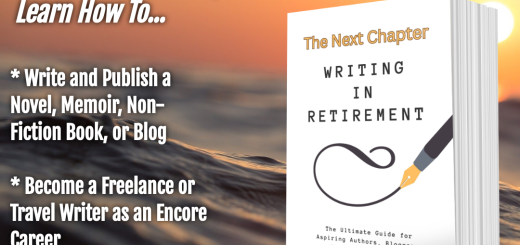
Want to learn more about writing for profit or for pleasure ? My book, The Next Chapter: Writing in Retirement, was created to help aspiring writers take that first step. With plenty of encouragement and help, you’ll explore all the many options available today.
Once you decide which direction to take, this comprehensive book will guide you down your path with easy-to-understand steps to help turn your words into something meaningful.
For even more inspiration, join our growing Next Chapter Writers Community and receive FREE monthly writing inspiration, creative prompts, and practical tips designed especially for retirees and aspiring writers.
What are you waiting for? Your next chapter may just be your best one yet.



This is an excellent portrayal of the up-and-down nature of a writer’s life…or probably of any creative endeavor. I am about to spread it far and wide on my social media sites. Thanks so much. I always feel better when I know that I am not the only person to feel/endure negative things. If it kind of goes with the territory, then it is so much easier to soldier on!
Ain’t easy, right? And THANKS so much for sharing the article on your social media sites!
Thanks for this piece about writing and specifically about writing in retirement. I will be 62 soon and have been writing just for myself for a few years. With DISCIPLINE in retirement I wonder what might happen …. I have practised meditation for 15 or so years now. That is a regular daily “habit”. In retirement I intend to treat daily writing as a similar “practise”. That and exercise. Both writing and exercise are now relegated to less than daily practise …. Without the necessity of the daily 9to5 grind, with the freedom of time and energy …. Well, thanks for the encouraging words.
Glad you enjoyed the article and I wish you the best of luck with all your writing endeavors!
What I love most about this is your honesty, candor- the truth. I have no aspirations to be a writer but I do have to write my weekly blog for my product and online business. Some topics come easily, some not. Some get great comments, some not. In fact, the one I wrote for this week I think is one of the best but alas, people seem to be away and very few comments are being left. Worse is it is hardly being seen. Talk about hi’s and low’s. Thanks for sharing your experience. I feel better.
I am happy to share my experience; it is one that virtually every writer shares. And you’re right – bloggers experience similar highs and lows as well. Is it all worth it in the end? In my case, I would answer with a resounding yes!
There is a lot of candor in your post, Julie, and your readers appreciate that. So many times the challenges in a business or creative process are hidden, and only the “ups’ are talked about. The “downs” are usually glossed over. You revealed both sides, but I also like the sage advice you gave as well. Excellent post. Thank you.
Thanks, Yvonne. I’m all about honesty. I think aspiring writers should know what they’re getting into – and if they were really meant to be writers, they’ll forge ahead despite all the challenges.